
A war was just declared while we scrolled through our timelines. Again. This time, the US and Israel launched major combat operations against Iran.
That means you will now encounter videos and photos of war alongside your friends’ Instagram updates or your favourite influencer’s TikTok. Quickly, social media platforms will be spaces where we are witnesses and spectators of war. War footage will become another piece of content that we scroll through in our everyday lives.
But encountering war through social media is more complicated than that. Not only do platforms shape how we make sense of war. Increasingly, they are an active part of it.
War has entered your feed: spectatorship in our timelines
Seeing war unfold in our timelines does more than simply represent acts of armed violence.
Scholars such as Constance Duncombe have argued that seeing violence on digital platforms such as X, Instagram, or WhatsApp doesn’t merely inform our thinking about tragic events. Instead, these platforms give us a framework through which we make sense of the violence itself.
So, for instance, when our perspective of war is shaped by videos of bombings from the US and Israel on Iranian soil, we are forming an internal structure of what this war entails. That can be, in the case of the bombing videos, an idea of an uneven war (unilateral bombings) or of a war without faces (neither showing those who carry out the attacks nor their victims).
And such structures matter, tremendously.
More importantly, these structures matter because they shape the feelings that circulate between us when we see the violence. Feminist thinker Sara Ahmed argues that emotions like fear (a common affective response to images of bombings) are not just personal reactions; they are social forces that states routinely harness to build compliance and consent. We are supposed to be scared of war, to be afraid of ‘the other,’ to be vigilant of our surroundings.
Therefore, the emotions we encounter in footage of war on social media, such as fear and anger, are not neutral: they already contain a judgment about what this war means.
As a consequence, being a spectator of war on social media promotes a narrative of whose lives count and whose lives are disposable. Or, as philosopher Judith Butler puts it, a narrative about whose lives are seen as worth grieving at all. What I mean by this is that social media retellings don’t just tell us who the villains are: they tell us who counts as a person at all.
It is possible that we will see many stories in the future days of Iranian kids and American soldiers killed in combat (lives that are seen as very grievable), but we are less likely to see the faces and stories of other civilians injured (for instance, homeless people, whose lives are treated as less worthy of mourning).
Not all deaths on our timelines are created equal. The platforms we engage with shape whose death counts as a tragedy and whose lives don’t count at all.
Platforms don’t just show war: they shape it
Given their power to shape how we feel and make sense of events, social media platforms are not neutral actors of war. Think of simple platform features, such as content recommendation systems or interactive features like the like button.
At first, they might seem inconsequential (and even positive) features of the internet. But they are not. Check the content being recommended to you about the war on TikTok right now, and wonder: whose content is being promoted in your timeline, and who gets to decide what the algorithm prioritizes? Think of the last war video you saw on Instagram and wonder: what are the consequences of having the quickest reaction to a video of war being a “like” button? In this way, each feature or moderation rule set designed by platforms is consequential in shaping how we, as a society, make sense of war.
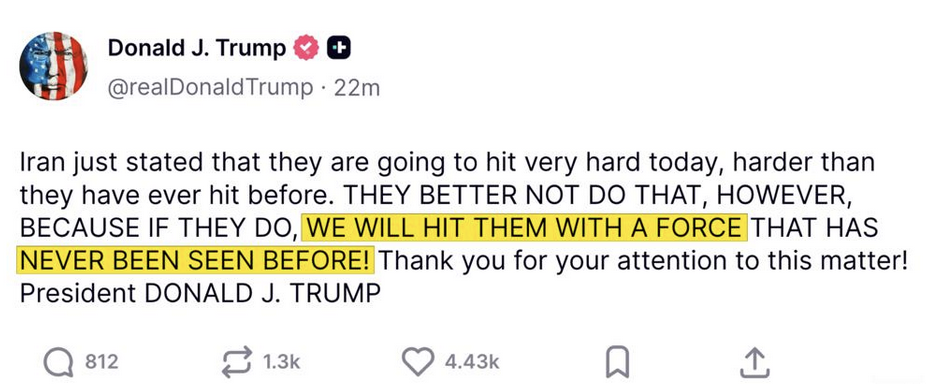
And governments are very much aware of this. It is no coincidence that Trump first announced his war efforts on Truth Social (where his followers can first react to the content), or that X has become a space where right-wing influencers push narratives of the ongoing war efforts (where moderation on misinformation is lax).
If social media platforms are where societies increasingly make sense of war, states are working hard to control that process. And that would be concerning enough on its own. But it is made worse by the platforms’ own political and economic interests. As Trump’s inauguration made clear, the most powerful social media companies are aligned with the current administration.
Such strategic alliances between platforms and governments mean that states’ use of war footage and narratives is only the visible part of a larger effort to shape what we see. We cannot always know how platforms decide whose voices to amplify and whose to suppress. That may sound like conspiracy thinking, but you only have to look at TikTok’s handling of ICE protests in the US to see it is a documented reality.
Whose timeline is it anyway?
War will continue to appear in our timelines, right there, between selfies, memes, and sponsored posts. War content is no longer an exception but a condition of digital life. What is more, and as I have argued here, social media platforms are now active participants in how wars are narrated, felt, and made meaningful. They shape what we see, how we react, and whose lives become visible or ignored.
Yet this does not mean that platform narratives are all-powerful, nor that we are merely passive spectators. On the contrary: the meanings of war are never fully settled. They are contested, reinterpreted, resisted, and sometimes refused. And that matters because it means that our engagement with war content is never just consumption: there is always space to question what we are being shown.
So if war now unfolds on our timelines, we must think of scrolling itself as a political act. One that demands we ask: what is being shown to us, and what isn’t? Whose reactions are being amplified, and by whom? Which platforms are we choosing to rely on, and what interests shape them? These are not abstract questions. They are the questions that determine whose lives we see, whose suffering registers, and whose deaths we are taught to grieve.
War, then, is in our timelines. The least we can do is pay careful attention to what that means.
